
Resources



Helpful tools to get you started
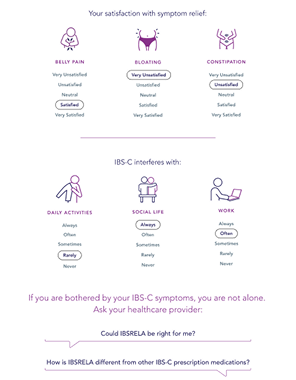
Interactive IBS-C Check-in Tool
Don’t be okay with feeling just okay. If you continue to have IBS-C symptoms that bother you, it may be time to assess their impact and consider trying something different. Use our interactive tool to create a personalized guide to help you have a conversation with your healthcare provider at your next appointment.
Check my symptoms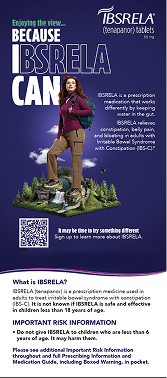
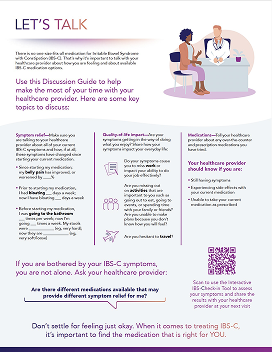
Doctor Discussion Guide
Different treatments work for different people. If you continue to have IBS-C symptoms, download this guide to talk to your healthcare provider and find a treatment that’s right for you.
Download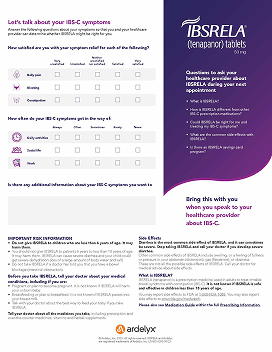
Downloadable IBS-C Check-in Tool
Everyone’s journey with IBS-C is different. This guide meets you where you are, helping you ask the right questions and talk to your healthcare provider about finding relief from your IBS-C symptoms.
Download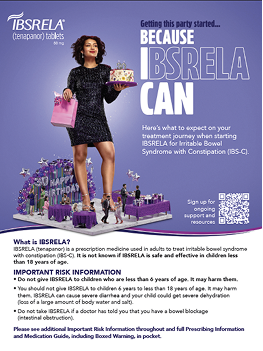
Quick Start Guide
Starting IBSRELA? This guide walks you through what to expect and how to stay consistent with your medication.
Download it to get helpful tips and support as you begin your journey.
Download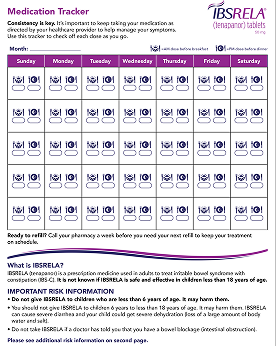
Medication Tracker
Stay on track with your medication. Use this printable guide to record your daily doses each month and keep your progress visible.
DownloadIBS-C voices: patient stories
Real patients tell their stories about living with IBS-C and how IBSRELA helped them.

The Importance of Shared Decision-Making
Hear From an Actual Patient About Her Success With Symptom Relief Taking IBSRELA
Watch Suzanne talk about finding the medication that’s right for her and her IBS-C,* with the help of Susan, her trusted healthcare provider.†
Title Screen with IBSRELA Indication and Boxed Warning
ON SCREEN/SUPER: Suzanne
Retired nurse, patient with IBS‑C
Suzanne VO:
Hi my name is Suzanne. I’m a retired nurse from Michigan. I’m here today to tell you a little bit about my experience living with Irritable Bowel Syndrome with Constipation, or IBS‑C. I’m joined by Susan, my nurse practitioner who works with me to manage my IBS‑C, and whom I can’t say enough wonderful things about. Susan has been my savior, and I feel very fortunate to have her. She understands me and my condition—and has been committed to working with me to find the IBS‑C treatment that works for me.
IBS‑C very much impacted my ability to live my life. I used to go 14-15 days without a bowel movement—and I had terrible cramping and bloating. I remember my clothes were so tight. I love to go camping with my husband—and now that we are retired, we have plenty of time to do so. But I never wanted to leave the house just in case I got the urge to go to the bathroom. And the abdominal pain and bloating were so bad—I really didn’t feel like doing much of anything.
I took an over-the-counter medication for a while but it didn’t work for me. I would still go a week or more without a bowel movement—and still had terrible abdominal pain and bloating. I tried a prescription medication for IBS-C—but it didn’t work for me either. Before I saw Susan, I was feeling discouraged.
ON SCREEN/SUPER: Susan Wolgamott, DNP
Susan is a compensated advisor to Ardelyx.
Susan VO: Hi, my name is Susan. I am a nurse practitioner in Michigan. I have so many patients like Suzanne, who are suffering because of their IBS‑C. I think as healthcare providers, we sometimes forget the impact that conditions like IBS‑C have on our patients. This is not just a nuisance disorder—it is a condition that can have a very negative impact on patients’ quality of life.
Because there are many potential underlying causes of IBS‑C, there is no one-size-fits-all treatment approach. It’s a lot of trial and error to find the right medication for each individual patient. It’s important that patients understand that. That’s why I let my patients know that we have different medications to treat IBS‑C.
I also talk to my patients about the importance of good two-way communication, because this is a collaborative, joint decision-making process. I make sure my patients know that we will work together to find the treatment that is right for each of them.
And there’s nothing more satisfying than finding the right treatment for a patient. For Suzanne, it was IBSRELA, which works differently than other IBS‑C prescription medications. And I think that if a patient is on a medication that isn’t working for them or giving them symptom relief they are looking for, it makes sense to try something different. While IBSRELA was right for Suzanne, some patients experience side effects with IBSRELA, like diarrhea, swelling or a feeling of fullness in the abdomen, gas, or dizziness.
ON SCREEN/SUPER: The most common side effects of IBSRELA include diarrhea, swelling or a feeling of fullness in the abdomen, gas, or dizziness.
Suzanne VO: Since starting IBSRELA about a year ago, my symptoms have improved. I no longer feel the bloating or pain like I did before. I go to the bathroom more regularly, which I haven’t been able to do in many years. This has been my experience with IBSRELA and other people may have different experiences. Because my symptoms are better managed, I am able to go camping with my husband and spend time with my grandkids. My husband and I both lost our first spouses early—we know that life is short. We want to be able to do the things that bring us joy. I am so grateful that Susan was committed to helping me find a treatment that was right for me.
ON SCREEN/SUPER: Individual results and experiences may vary.
Susan VO: It gives me joy to help patients like Suzanne. I think the key is good communication between patients and healthcare providers. I feel it is my responsibility to let my patients know that there are different options available, and to offer them different treatment options.
When I suggested trying IBSRELA to Suzanne, I didn’t know if it was going to work for her, but she and I agreed that it would be worth trying. And I am so glad we did!

The Impact of IBS-C and Finding IBSRELA
Hear From an Actual Patient, Regina, Who Is Taking IBSRELA for Her IBS‑C Symptoms
Regina is a longtime IBS-C sufferer.* Her IBS-C symptoms have kept her from doing what she enjoys. Hear how IBSRELA has helped her.†
ON SCREEN/SUPER: Regina is a real patient with IBS‑C, taking IBSRELA, who has been compensated for her participation in this video.
Regina VO:
My name is Regina, I live in New York. I’ve been married for 12 years, together for 15. I have four children. I like to read, I like to garden. I like to socialize. I like to visit wineries. I like to cook. I like to bake.
ON SCREEN/SUPER: On IBS‑C symptoms and diagnosis
Regina VO: My first experience with IBS‑C was with bloating, was with the constipation and pain. I was diagnosed approximately 10 years ago, 8 to 10 years ago, was my official diagnosis, but I have had this for a very long time.
Regina VO:
IBS‑C has impacted my relationships by basically putting a huge strain on my social life. It has affected me physically. I have been in so much pain that when my children were small, there were many things I had to miss out on...I have had to miss out on family functions, some friends when I tell them that I can’t go, that I’m not feeling well, and I have to say that a lot…after a while, they just get very frustrated and they just stop calling. You know, it’s very easy for someone to say, oh, you know what, just take a pill. Just, you know, take something over the counter. But it doesn’t work that way.
ON SCREEN/SUPER: On talking with her doctor about IBS‑C prescription medications
Regina VO: After my diagnosis with my first prescribed treatment, I left the doctor’s office very happy that I had a name to the symptoms that I had. She had given me a medication, and she did tell me that it did have side effects, that it would help me go to the bathroom, and I was actually very happy to know that there was something out there that could help me.
…my doctor…ended up taking me off of that medication because it did not work for me. It worked for a certain amount of time and then it stopped working and then my doctor prescribed me other medications, which did not work at all.
ON SCREEN/SUPER: On discussing IBSRELA with her doctor
Regina VO: When my doctor and I first started talking about IBSRELA, she told me it was different from the other medications I had already tried. That’s a big reason why I was so excited to take IBSRELA.
ON SCREEN/SUPER: On her experience taking IBSRELA® (tenapanor)
Disclaimer: The most common side effects of IBSRELA include diarrhea, swelling or a feeling of fullness in the abdomen, gas, or dizziness.
Regina VO: Since starting IBSRELA, I now go to the bathroom more regularly. It has also helped with my abdominal pain and my bloating. Before starting IBSRELA, my doctor and I discussed the possible side effects, one of which was loose stool. This isn’t the only side effect, and some patients may experience others. It’s important that patients talk to their healthcare providers about all possible side effects.
I can only speak for myself. This is only my, how it affects and helps me…everybody is different.
ON SCREEN/SUPER: On her IBS‑C symptom relief
Disclaimer: Regina’s experiences are specific to her. Individual experiences and results may vary.
Regina VO: Now that I’m taking IBSRELA and it relieves my symptoms, I’m able to get up in the morning, I’m able to plan my day…I can now make plans and go out with my husband and my friends. I’m able to travel and I recently went to Italy with my daughter. I didn’t have to worry about not being able to go to the bathroom, not being able to enjoy myself, not being in so much pain, we had a ball...
Other people may have different experiences with IBSRELA, but I feel like I’ve gained some of my life back.
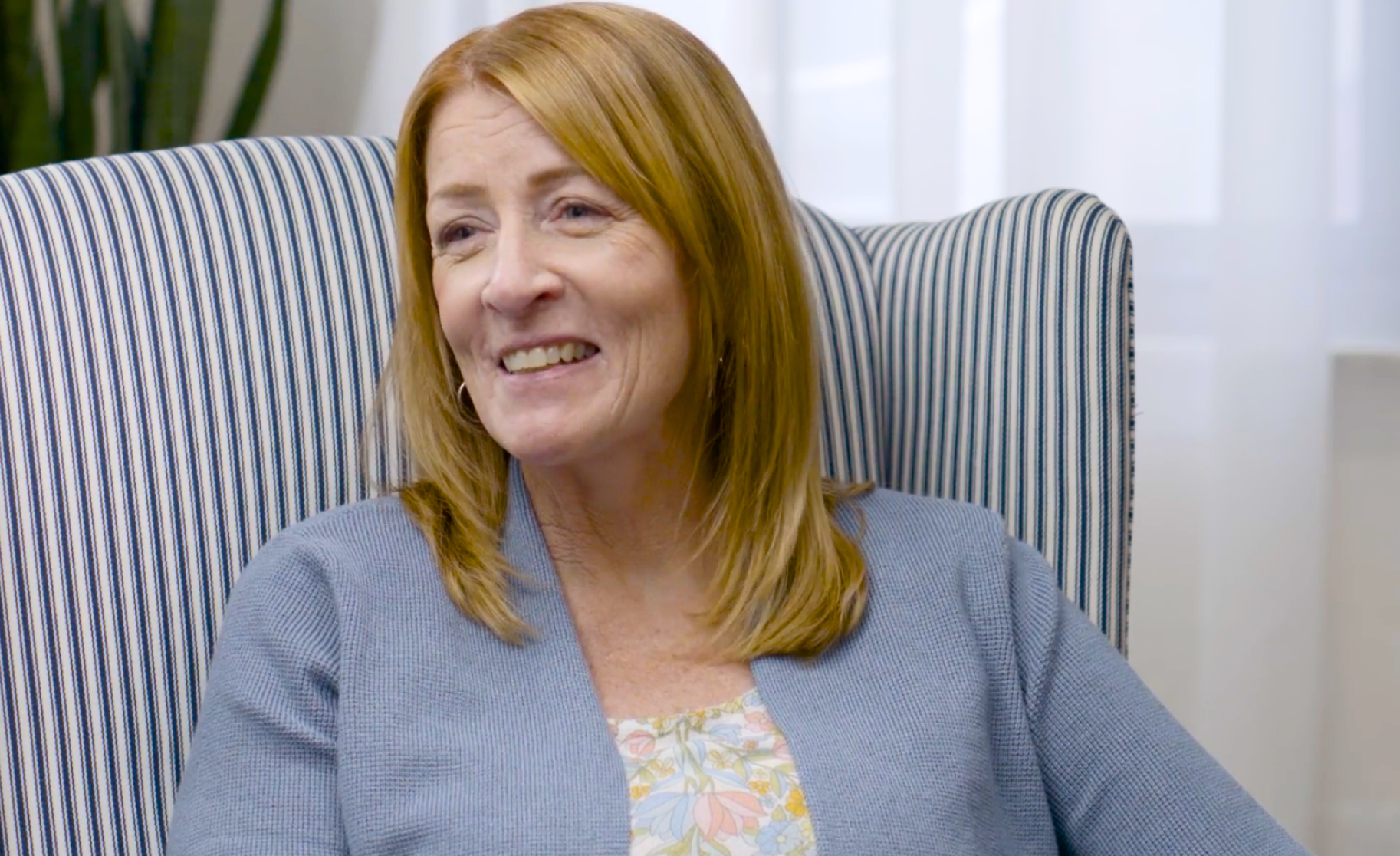

From Missing Out to “Count Me In.”
Hear From an Actual Patient, Suzanne, About Getting Back to the Activities She Enjoys With IBSRELA
Suzanne lived with IBS‑C symptoms for years, going many days without relief.* Now with IBSRELA, she’s getting back to camping with her husband and spending time with her grandkids. Hear her story.†
ON SCREEN/SUPER: Suzanne
Retired nurse, living with IBS‑C
Suzanne VO:
Since starting IBSRELA about a year ago, I go to the bathroom more regularly, which I haven’t been able to do in many years.
For me IBSRELA has made a difference in my symptoms. I no longer feel bloating and pain like I did before. Because my symptoms are better managed, I am able to go camping with my husband and spend time with my grandkids.
ON SCREEN/SUPER: Individual results and experiences may vary.
Suzanne VO:
While this has been my personal experience with IBSRELA, other people may experience some side effects such as diarrhea, swelling or a feeling of fullness in the abdomen, gas, or dizziness.
IBS-C voices: expert guidance
Healthcare providers share their experiences with how they assess and treat patients with IBS-C.

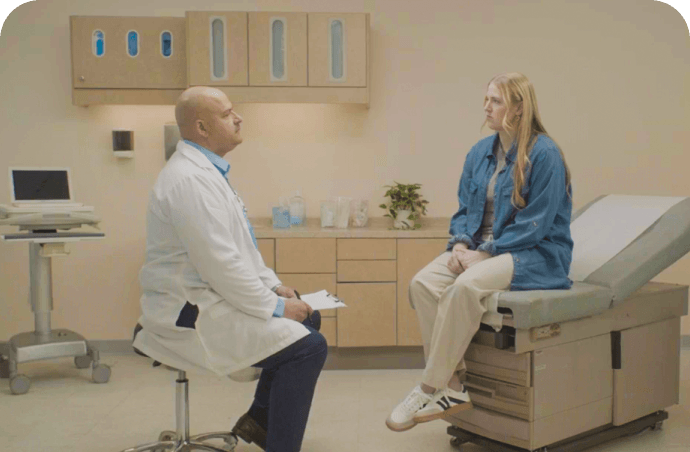
What “Better” Really Means
Behind The Conversation Episode 1
When Sarah says she’s “feeling better,” her doctor digs deeper to quantify her symptoms—and they both realize it’s time to try a medication that works differently.
ON SCREEN/SUPER: BEHIND THE CONVERSATION
Please see Medication Guide and Boxed Warning within full Prescribing Information at IBSRELA.com/pi.
THE NUMBERS TELL THE REAL STORY | EPISODE 1
Doctor VO: Good to see you, Sarah. It’s been 3 months on treatment for your IBS with constipation. How are your symptoms?
Patient VO: Better. My bowel symptoms have improved, but I still have belly pain.
Doctor VO: “Better” is vague. I need to quantify her treatment response.
OK Sarah, in the past 7 days, how many days with pain?
Patient VO: I’d say that I’ve had pain 5 out of the past 7 days. So, most of the time. Being asked about the last week made me realize how much I’m still dealing with lingering symptoms.
Doctor VO: 1 to 10, with 10 being worst pain?
Patient VO: Most days are about a 6.
Doctor VO: Without quantifying frequency and level of severity, I wouldn’t have recognized Sarah is still struggling with abdominal pain. “Better” doesn’t tell me what she is still experiencing.
Patient VO: Six out of 10 on most days with stabbing pain and feeling like I have a bowling-ball in my gut.
Doctor VO: Sarah, with pain at a 6 most days…you may not be getting the relief you want. Since the causes of IBS-C may be different for each person, we may have to try different medications to find the one that’s right for you.
Patient VO: I guess I just settled. I didn’t know more relief was possible. It felt like having something—even if it wasn’t really what I wanted—was better than having nothing.
Doctor VO: There are other treatments that work a bit differently to help address what’s still bothering you. How do you feel about trying something different?
Patient VO: I guess I didn’t know it could be any better than this? I’m open to change, but also a bit nervous to go back to square 1, you know?
Doctor VO: We spoke a little bit about how this medication works and the possible side effects. I will give you more information to read. If you’re ready to try something different—I can send a script through today.
Patient VO: Great, I’m glad I’m getting more information—I guess I just got used to the relief from my current treatment. Good thing you asked me.
ON SCREEN/SUPER: You don’t have to settle for feeling just okay.
When you share how often your symptoms still affect you, your healthcare provider can help find a medication that works best for you.
IBSRELA is a prescription that works differently than other medications to treat the symptoms of IBS-C.
Relieving constipation, belly pain, and/or bloating*
Providing rapid symptom improvement beginning as early as 1 week
Showing additional improvement in belly pain and bloating during the first 3 months of treatment*
Diarrhea is the most common side effect of IBSRELA, and it can sometimes be severe.
These results were observed in the study, but the analysis cannot be used to draw conclusions.
*Results may vary. Study results seen in 12- and 26-week trials. In adults with IBS-C, more patients taking IBSRELA experienced an overall response for 6 or more of the first 12 treatment weeks than those not taking IBSRELA.
This video contains real and AI-generated elements.
Ask your doctor if IBSRELA could be right for you. You could pay as little as $0.*
*Terms and conditions apply. For patients with commercial insurance.
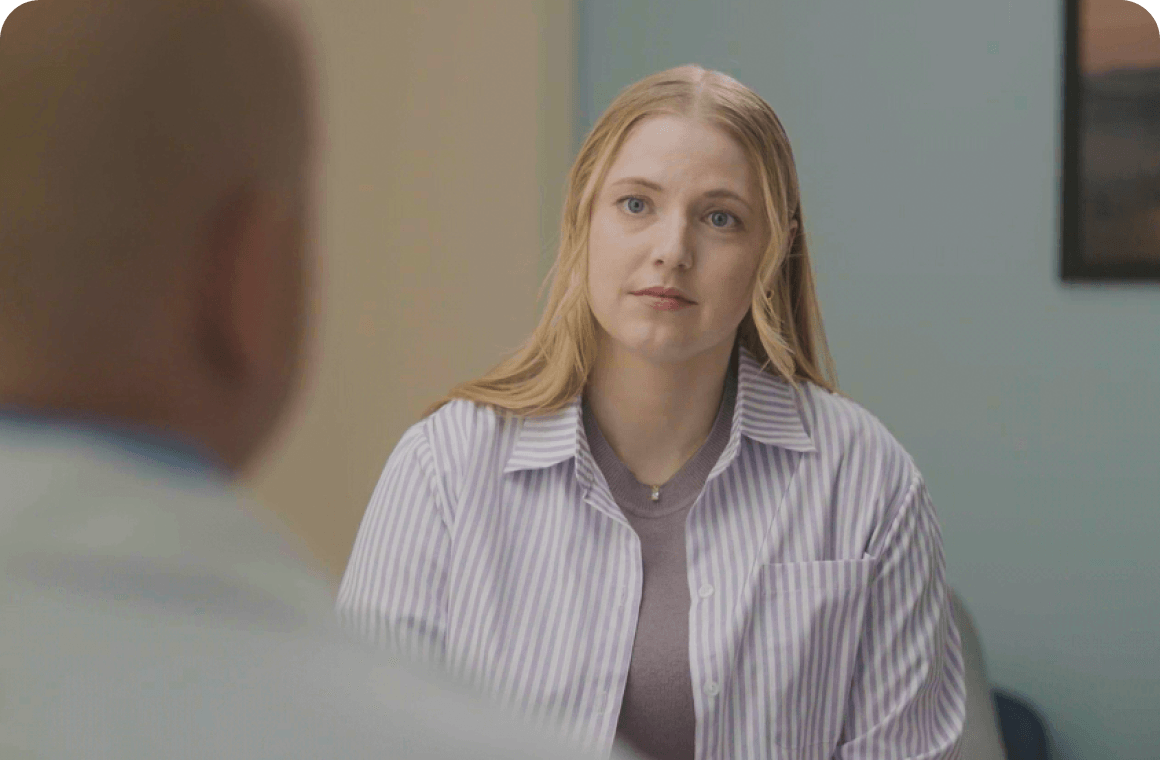
Still Planning Around Symptoms
Behind The Conversation Episode 2
When Sarah explains how her symptoms are dictating her daily life, her doctor looks at the bigger picture; and together they decide it’s time to try something different.
ON SCREEN/SUPER: BEHIND THE CONVERSATION
Please see Medication Guide and Boxed Warning within full Prescribing Information at IBSRELA.com/pi.
STILL PLANNING AROUND SYMPTOMS | EPISODE 2
Doctor VO: Good to see you again, Sarah. It’s been 3 months since we started your IBS-C treatment. How are you feeling?
Patient VO: Not great. I’m avoiding meetings. I called in sick twice last week and I’m canceling on friends.
Doctor VO: Sounds like you’re planning your life around your symptoms. Is that right?
Patient VO: I have to.
Doctor VO: Sarah is avoiding meetings and social plans because of IBS-C symptoms. I always try to find out how my patients’ symptoms are really affecting daily life. Symptom severity is one thing; daily impact gives us the bigger picture.
You’re getting some relief, but you’re still planning your whole day around IBS-C symptoms. That tells me we’re not quite where we need to be.
Patient VO: Okay, what is next?
Doctor VO: IBS-C treatment isn’t one-size-fits-all. Sometimes different medications work for different people. There are different treatment options that are available.
Patient VO: I didn’t know there were other options that are different from what I started on.
Doctor VO: There are! Let’s talk about how this other medication works and the side effects that you might experience. I can give you more information to read. And if you’re ready to try something different—I can send a script through today.
Patient VO: I came in thinking I was just looking for a refill. My symptoms are still running my life and I don’t want to keep feeling like this. I’m glad my doctor told me there are different options available for me to try.
ON SCREEN/SUPER: If you’re still canceling plans, avoiding meetings, or planning around your symptoms—don’t settle for feeling just okay.
IBSRELA is a prescription that works differently than other medications to treat the symptoms of IBS-C.
This video contains real and AI-generated elements.
Ask your doctor if IBSRELA could be right for you. You could pay as little as $0.*
*Terms and conditions apply. For patients with commercial insurance.

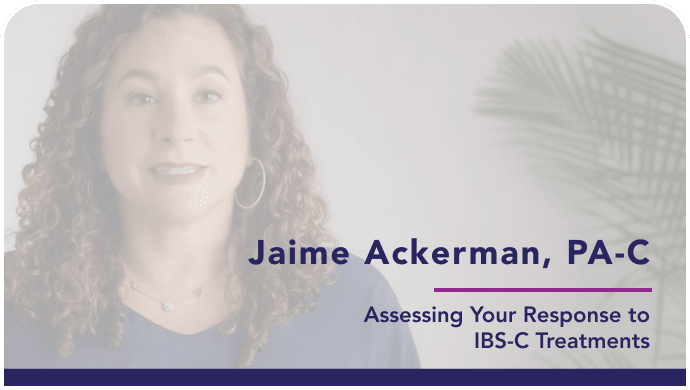
Assessing Your Response to IBS-C Treatments
Hear From a Physician Assistant About How She Approaches Helping Her Patients Find IBS‑C Relief
See how Jaime,† a physician assistant who treats many patients with IBS‑C, works with her patients to ensure they get optimal IBS‑C symptom relief.
ON SCREEN/SUPER: Jaime Ackerman, PA-C
Jaime is a compensated advisor to Ardelyx.
Jaime VO:
Hi, I’m Jaime Ackerman and I’m a PA in Atlanta and have been working in GI for 20 years.
I see many adult patients with IBS‑C in my practice: approximately 5 per day. My patients often tell me that the symptoms of IBS‑C, constipation and pain and bloating, make them miserable and that they have to plan their life around their IBS‑C. I want to do everything I can to help them find relief. The introduction of IBSRELA for the treatment of adults with IBS‑C has been exciting for me. Having a medication with a different mechanism of action and the first in its class, has given me more options to offer my patients, and importantly, different classes of medications for my patients.
ON SCREEN/SUPER: The most common side effects of IBSRELA include diarrhea, which can sometimes be severe, swelling or a feeling of fullness in the abdomen, gas, or dizziness.
Jaime VO: I let patients know that I will do everything I can to get them better. I want my patients to feel confident that I can help them, which is why it’s important to let patients know there are different medications available and that we will keep trying different things until we find what’s right for them. But I don’t want them to think we are just throwing medications at them; I want them to know that we have a strategy, a plan. So, explaining that there are different classes of medications and that if a medication in one class doesn’t work, we will go to another class, helps give patients confidence and hope.
The first step in treating IBS‑C is asking the right questions. You don’t know the answer if you don’t ask the question. And the way we ask questions is important. If we just ask a patient if their symptoms have improved, we don’t get at how much their symptoms have improved; the question doesn’t differentiate between a little improvement and a lot of improvement. So, instead of asking has your bloating improved, I ask are you still having any bloating? If the answer is yes, I dig in to find out more; how often are they having bloating, how much of an impact it is having on their quality of life. So, instead of asking if their symptoms have improved, I ask if they are still having symptoms. That is my starting point and helps me make sure I don’t miss patients who may be a little better, but still suffering from symptoms. And it’s important to know this, because with more treatment options available, if a patient is still having symptoms, I want us to consider trying a medication that works differently, that is part of a different class, because my goal is to help my patients get as much symptom relief as possible.


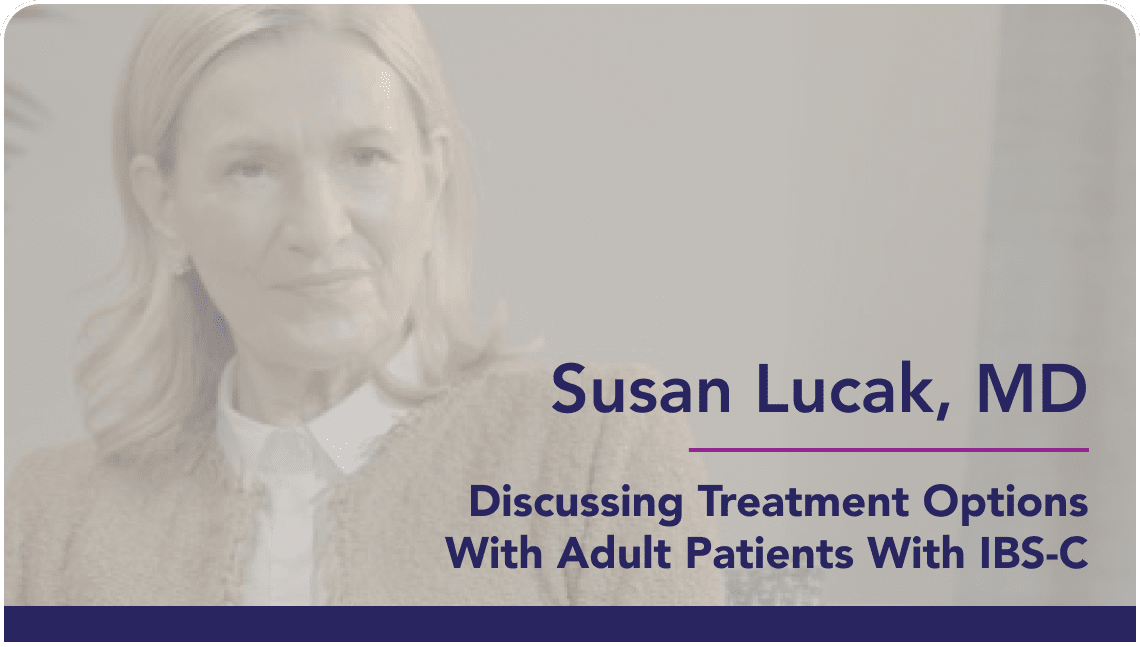
Discussing Treatment Options With Adult Patients With IBS-C
Hear From a Doctor About Why Patients Should Understand All Treatment Options Available for Their IBS‑C
Watch how Dr. Lucak,† a gastroenterologist who works with many patients with IBS‑C, helps her patients find the treatment that works for them.
Title Screen with IBSRELA Indication and Boxed Warning
ON SCREEN/SUPER: Talking to Patients About IBS‑C
Susan Lucak, MD
Gastroenterologist
Susan Lucak is a compensated advisor to Ardelyx.
Susan VO:
So, when those symptoms are not taken seriously, then patients doubt themselves. They said, “Is this in my head? What is this?” And then they try to see, “Okay, maybe I’m not eating well and I’m not eating the right things, and maybe it’s kind of my fault a little bit.” And then finally when they arrive at my door, I tell them it’s not in their heads, that it’s a true medical condition, these symptoms are common among people who have this subtype of IBS‑C, and that we have now, again, treatment options to offer them and to try. And that is very, in a way, kind of liberating to patients. They feel all right, they have hope and, “maybe some of these treatments will work for me.” Sometimes patients sort of have suffered in silence for many years, and then finally they just can’t take it. Because they had given up, they had given up. And so, when they come, it’s a big step for them because for many years, they just thought, “Oh, nothing can be done about this.” And so when they come, it’s something important to just give them and offer them these options for the treatment of their IBS‑C.
ON SCREEN/SUPER: IBS‑C Treatment Options
Susan VO: Now and over the last couple of years, we have had more options. And so, the more options we have for patients with IBS‑C, that is really great because we can then offer those options to them and if they don’t respond to one type of treatment, then we can offer another type of treatment.
ON SCREEN/SUPER: Finding the Right Treatment Option for Each Patient
Susan VO: Sometimes, when I use one treatment, it may help partly but not fully, and then we explore another treatment, and then sometimes we go back to treatment number one. So, it is good to have patients have the idea that there is more than one treatment there because if it doesn’t work, then they can go and explore another treatment. When I describe this to my patients, they oftentimes walk out of the office feeling, “Look, I have hope now that there is something there for me.” And I think that is really important to know about treatment of IBS‑C at this time.


Treating Adult Patients With IBS-C
Hear From a Doctor About the Importance of Finding the Right Treatment
Watch Dr. Harris,† a gastroenterologist who treats many patients with IBS-C, talk about the importance of understanding how IBS-C symptoms affect patients’ lives.
Title Screen with IBSRELA Indication and Boxed Warning
ON SCREEN/SUPER: Treating Adult Patients With IBS‑C
Lucinda Harris, MS, MD, FACG
Gastroenterologist
Lucinda Harris is a compensated advisor to Ardelyx.
Lucinda VO:
What I like about treating IBS‑C patients, and maybe just IBS patients in general, is that every patient’s a bit of a mystery. They have a story to tell. I kind of look at it, “What are the clues and the ways in which I can help them?” I always look also to, “How can I help? What can I focus on that’s going to help them feel better?” Because that’s what I want to do when I see patients, is help them to feel better.
ON SCREEN/SUPER: Importance of Understanding How Symptoms Affect Patients’ Lives
Lucinda VO: When you understand about the severity of a patient’s symptoms, you understand more about how they live with a disease, and you understand how it impacts them. Do they not date? Or do they not go to work?
ON SCREEN/SUPER: Assessing Patients With IBS‑C
Lucinda VO: So, when I see a patient back who has IBS, I try not to just focus on the number of bowel movements. I think it’s important to ask them about their abdominal pain, but I also think it’s important to ask them about their lives. “How are things going? Has this really made an impact on your life, this treatment?”
For IBS patients now, there are a lot more treatment options, so that’s really good. I think that patients just think, “Well, they’re just going to tell me, ‘Go have more fiber,’ or ‘Go drink more fluid.’” I think it is really important to remind patients that there are different options for treatment.
ON SCREEN/SUPER: Treatment Expectations in IBS‑C
Lucinda VO: My expectations for treating patients with medications for IBS‑C is certainly that I want to see an improvement in the number of bowel movements they’re having, but also, I want to have an impact on their pain, and I want to see their pain decrease as well. I think that one of the most challenging aspects about treating IBS‑C is addressing that abdominal pain.
So, if you see a patient and you’re using one mechanism of action for a medication, I think if that medication is not working for them. You can both make a point to the patient that, “Maybe we need to try something else.”
ON SCREEN/SUPER: Finding the Right Treatment for Each IBS‑C Patient
Lucinda VO: It makes my day when a patient comes back and tells me that a medication has worked. It’s really a great feeling that you found something that works for them.

Working Together to Make Decisions
Hear From a Nurse Practitioner About How There’s No One-Size-Fits-All Approach to Treating IBS-C
See how Susan,† a nurse practitioner, works closely with her patients to help keep then informed about different IBS-C medications.
ON SCREEN/SUPER: Susan Wolgamott, DNP
Susan is a compensated advisor to Ardelyx.
Susan VO:
Because there are many potential underlying causes of IBS-C, there is no one-size-fits-all treatment approach.
That’s why I let my patients know that we have different medications to treat IBS-C, which is good because there are many underlying causes for this condition, and classes of drugs work differently for different people.
I also talk to my patients about the importance of having good two-way communication between us. There will be a lot of trial and error to find the right medication for each patient, but with a collaborative, joint decision-making process, we will work together to find the treatment that is right for them.
*Individual results and experiences may vary.
†Healthcare providers are compensated advisors to Ardelyx, and patients have been compensated for their participation.
IBS-C communities






We’re partnering with the LPGA to redefine the conversation around IBS-C. Just like athletes adjusting their strategy mid-game, it’s important to talk to your doctor about your IBS-C treatment plan when it isn’t working for you.

IMPORTANT RISK INFORMATION
- Do not give IBSRELA to children who are less than 6 years of age. It may harm them.
- You should not give IBSRELA to children 6 years to less than 18 years of age. It may harm them. IBSRELA can cause severe diarrhea and your child could get severe dehydration (loss of a large amount of body water and salt).
- Do not take IBSRELA if a doctor has told you that you have a bowel blockage (intestinal obstruction).
Before you take IBSRELA, tell your doctor about your medical conditions, including if you are:
- Pregnant or plan to become pregnant. It is not known if IBSRELA will harm your unborn baby.
- Breastfeeding or plan to breastfeed, although IBSRELA is not expected to pass into your breast milk and to harm your baby. Talk with your doctor about the best way to feed your baby if you take IBSRELA.
Tell your doctor about all the medicines you take, including prescription and over-the-counter medicines, vitamins and herbal supplements.
Side Effects
Diarrhea is the most common side effect of IBSRELA, and it can sometimes be severe. Stop taking IBSRELA and call your doctor if you develop severe diarrhea.
Other common side effects of IBSRELA include swelling, or a feeling of fullness or pressure in your abdomen (distension), gas (flatulence), or dizziness.
These are not all the possible side effects of IBSRELA. Call your doctor for medical advice about side effects.
You may report side effects to FDA at 1-800-FDA-1088. You may also report side effects to www.fda.gov/medwatch.
What is IBSRELA?
IBSRELA (tenapanor) is a prescription medicine used in adults to treat irritable bowel syndrome with constipation (IBS-C). It is not known if IBSRELA is safe and effective in children less than 18 years of age.
Please see full Prescribing Information and Medication Guide, including Boxed Warning.
What is IBSRELA?
IBSRELA (tenapanor) is a prescription medicine used in adults to treat irritable bowel syndrome with constipation (IBS-C). It is not known if IBSRELA is safe and effective in children less than 18 years of age.
You are now leaving IBSRELA.com
This link will take you to a site maintained by a third party, who is solely responsible for its contents. Ardelyx, Inc., provides these links as a service to our website visitors. Ardelyx, Inc., is not responsible for the content or Privacy Policy of any third-party websites. We encourage you to read the Privacy Policy of every website you visit.
IMPORTANT RISK INFORMATION
- Do not give IBSRELA to children who are less than 6 years of age. It may harm them.
- You should not give IBSRELA to children 6 years to less than 18 years of age. It may harm them. IBSRELA can cause severe diarrhea and your child could get severe dehydration (loss of a large amount of body water and salt).
- Do not take IBSRELA if a doctor has told you that you have a bowel blockage (intestinal obstruction).
Before you take IBSRELA, tell your doctor about your medical conditions, including if you are:
- Pregnant or plan to become pregnant. It is not known if IBSRELA will harm your unborn baby.
- Breastfeeding or plan to breastfeed, although IBSRELA is not expected to pass into your breast milk and to harm your baby. Talk with your doctor about the best way to feed your baby if you take IBSRELA.
Tell your doctor about all the medicines you take, including prescription and over-the-counter medicines, vitamins and herbal supplements.
Side Effects
Diarrhea is the most common side effect of IBSRELA, and it can sometimes be severe. Stop taking IBSRELA and call your doctor if you develop severe diarrhea.
Other common side effects of IBSRELA include swelling, or a feeling of fullness or pressure in your abdomen (distension), gas (flatulence), or dizziness.
These are not all the possible side effects of IBSRELA. Call your doctor for medical advice about side effects.
You may report side effects to FDA at 1-800-FDA-1088. You may also report side effects to www.fda.gov/medwatch.
What is IBSRELA?
IBSRELA (tenapanor) is a prescription medicine used in adults to treat irritable bowel syndrome with constipation (IBS-C). It is not known if IBSRELA is safe and effective in children less than 18 years of age.
Please see full Prescribing Information and Medication Guide, including Boxed Warning.
What is IBSRELA?
IBSRELA (tenapanor) is a prescription medicine used in adults to treat irritable bowel syndrome with constipation (IBS-C). It is not known if IBSRELA is safe and effective in children less than 18 years of age.